HERALD OF THE QUANTUM AGE: MAJORANA 1
By Darshana Muraly and Neha Nair
Introduction: of the groundbreaking quantum chip Majorana 1, Microsoft ushers in the newest age – The Quantum Age.
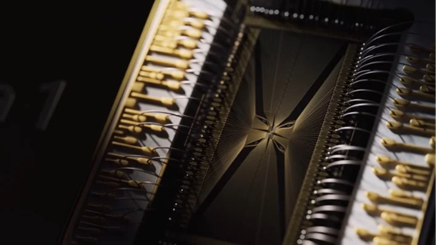
Fig.1
Now let’s start off with a basic introduction to quantum computing.
Quantum computing is a multidisciplinary field that utilizes quantum mechanics to solve complex problems way faster than classical computers.
The building blocks of quantum computers are qubits, the quantum equivalent to the classic bits 0 and 1. But unlike the classical bit, the qubit introduces a new state – a superposition state where it exists simultaneously as 0 and 1. This allows quantum computers to do many things at once, and perform certain calculations faster than classical computers.
However, regular qubits are delicate, they are unreliable and aren’t very resistant to noise.
Thus rose the need for an upheaval, a need for a whole new material to make up the quantum processing unit, something that has a certain level of built-in error-correction.
Let’s go back to 1937, when a young Italian theoretical physicist – Ettore Majorana, laid the theoretical foundation for a special particle – The Majorana fermion. This fermion is a particle that is its own anti-particle!
As opposed to Dirac fermions, which are like a traditional pair of gloves with one glove fitting only either the left or right hand, the Majorana fermion is like a special glove that fits either hand!
Majorana fermions remain one of physics’ longest-standing mysteries, a puzzle that could rewrite our understanding of fundamental particles. These particles could challenge core principles of symmetry in nature and even reshape our theories of the universe.
Few understand the scale of this challenge. As Microsoft CEO Satya Nadella put it: “After a nearly 20-year pursuit, we’ve created an entirely new state of matter, unlocked by a new class of materials, topoconductors, that enable a fundamental leap in computing.”
The topoconductor, or topological superconductor, is a special category of material that can create an entirely new state of matter – not a solid, liquid or gas but a topological state. This is harnessed to produce a smaller, faster, and more stable qubit that can be digitally controlled, redefining and vastly simplifying how quantum computing works. The topological qubit thus solves the noise problem faced by normal qubits, and reduces errors, creating the base for a whole new quantum architecture – the topological core. This topological core allows for the scaling of quantum chips to have not just hundreds or thousands, but millions of topological qubits on a single chip, opening the doors to computations that would have otherwise taken centuries.
What exactly is ‘topology’? And why is it resilient to noise?
Topology is when certain properties of a geometric object remain the same even when you change the shape of the object, i.e. deform it.
For example, both a donut and a mug have the common property of having a hole. Even if you squish, stretch or twist them, although they differ geometrically, topologically they remain the same, with a hole each. If we equate this application of deformity to noise affecting a qubit, you can start to see how topology introduces a layer of protection against noise, as the topological properties remain unaffected.

Fig. 2
How this all ties together, is with the titular Majorana particle.
Since Majorana fermions have not been seen, made, or directly observed in nature, Microsoft’s approach relies on Majorana quasiparticles – emergent, particle-like entities that arise from the collective behaviour of many interacting particles in a system, having the same properties as the real particle.
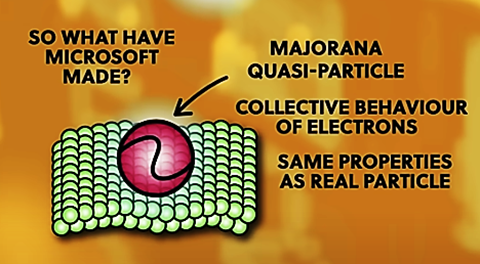
Fig. 3
The 0 and 1 state in a topological qubit is encoded in whether there is an even or odd number of electrons on a specific nanowire. This would however be easily disrupted by noise. So, to combat this, this information about its even or odd-ness is spread by the Majorana particle to both ends of the nanowire, making them non-local, and less susceptible to noise, as even if one end is disrupted, the other retains the information.
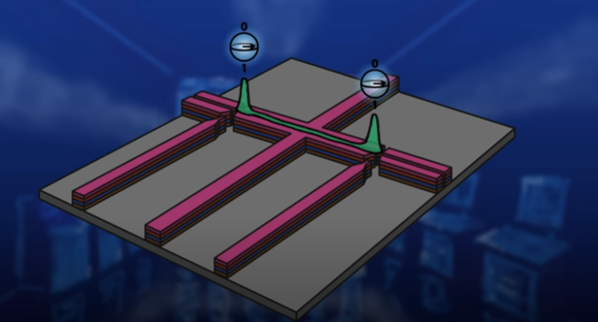
Fig.4
And thus, Microsoft has opened the floodgates with enhanced error correction and noise reduction, taking quantum computing to the next level.
But why is this interesting and important?
Majorana 1 has the potential to model molecular interactions with unprecedented accuracy. With the stability of topological qubits, researchers could analyse enzyme activity, unlocking new pathways for drug development, bioengineering and sustainable farming.
Tragic fictional deaths from rare diseases? Soon to be an outdated plot device; diseases are simply another complex problem waiting for quantum solutions.
Quantum simulations could lead to designing more efficient batteries, optimizing carbon capture, and advancing clean energy solutions to combat climate change. One of science’s biggest mysteries is the nature of the universe itself. Some scientists speculate that the missing mass in the cosmos—dark matter—could, in part, be composed of Majorana particles (true to their elusive namesake). If confirmed, this discovery could change how we understand the universe.
With great discovery comes great battles and even greater bottlenecks. The Majorana 1 chip promises a revolution, but are we truly prepared for what comes next?
Cybersecurity may be the first battlefield. Quantum computers could tear through today’s encryption like paper, leaving sensitive data exposed. The digital landscape we’ve built, in terms of banking, communication, and national security, could be rewritten overnight, and not necessarily for the better. In fact, a lack of appropriate measures could easily lead to global-scale cyber warfare.
Some physicists argue that the evidence for Majorana fermions is still unsteady at best. Even as Microsoft hails this as a breakthrough, scepticism lingers. Scientific revolutions don’t run on hype – they demand ironclad proof. And until that proof arrives, doubt will stick around.
Then there’s the million-dollar question: feasibility. The Majorana 1 chip depends on exotic materials like indium arsenide and aluminium, which are essential for superconducting conditions but expensive and challenging to work with. Even with advancements in topological quantum computing, maintaining stability and controlling quantum states remains an immense hurdle. Even if these technical challenges are overcome, another major barrier remains – commercialization and market readiness. Transitioning from a prototype to a commercially viable product involves addressing manufacturing scalability, cost reduction, and market acceptance. The high costs associated with the chip's materials and the need for specialized infrastructure may impede widespread adoption.
But perhaps the biggest paradox of all? We might not be ready for the power we are creating. Quantum computing could outpace our ability to integrate it responsibly. As Jason Zander put it, “The hardest part has been solving the physics. There is no textbook for this, and we had to invent it. We literally have invented the ability to go create this thing, atom by atom, layer by layer.” But physics is only the beginning. What follows could be an even greater challenge.
Despite the hurdles ahead, however, nobody can deny that with the creation of the Majorana 1, nothing will be the same again.
References and sources:
- https://news.microsoft.com/source/features/innovation/microsofts-majorana-1-chip-carves-new-path-for-quantum-computing/
- https://www.quera.com/glossary/majorana
- Majorana 1 Explained: The Path to a Million Qubits - YouTube
- Microsoft's Topological Quantum Computer Explained - YouTube
- https://en.wikipedia.org/wiki/Ettore_Majorana
- https://news.microsoft.com/source/features/innovation/microsofts-majorana-1-chip-carves-new-path-for-quantum-computing
- https://quantumzeitgeist.com/topological-quantum-computing-a-new-paradigm
- https://www.wsj.com/science/physics/microsoft-quantum-computing-physicists-skeptical-d3ec07f0
- https://nypost.com/2025/02/20/business/microsoft-it-created-revolutionary-majorana-1-chip-that-uses-new-state-of-matter
- https://timesofindia.indiatimes.com/technology/tech-news/microsoft-unveils-majorana-1-quantum-computing-chip-read-what-ceo-satya-nadella-has-to-say/articleshow/118416648.cms
- https://www.secureworld.io/industry-news/microsoft-majorana-1-quantum-computing
Fig 1**.** The Majorana 1 test chip in extreme close-up.
Source: https://hothardware.com/news/microsoft-majorana-1-quantum-breakthrough
Fig 2. Topological property image.
Source: Microsoft's Topological Quantum Computer Explained - YouTube
Fig 3. Quasiparticle image.
Source: Microsoft's Topological Quantum Computer Explained - YouTube
Fig 4. Non-locality of 0 and 1 by spreading Majorana.
Source: Microsoft's Topological Quantum Computer Explained - YouTube